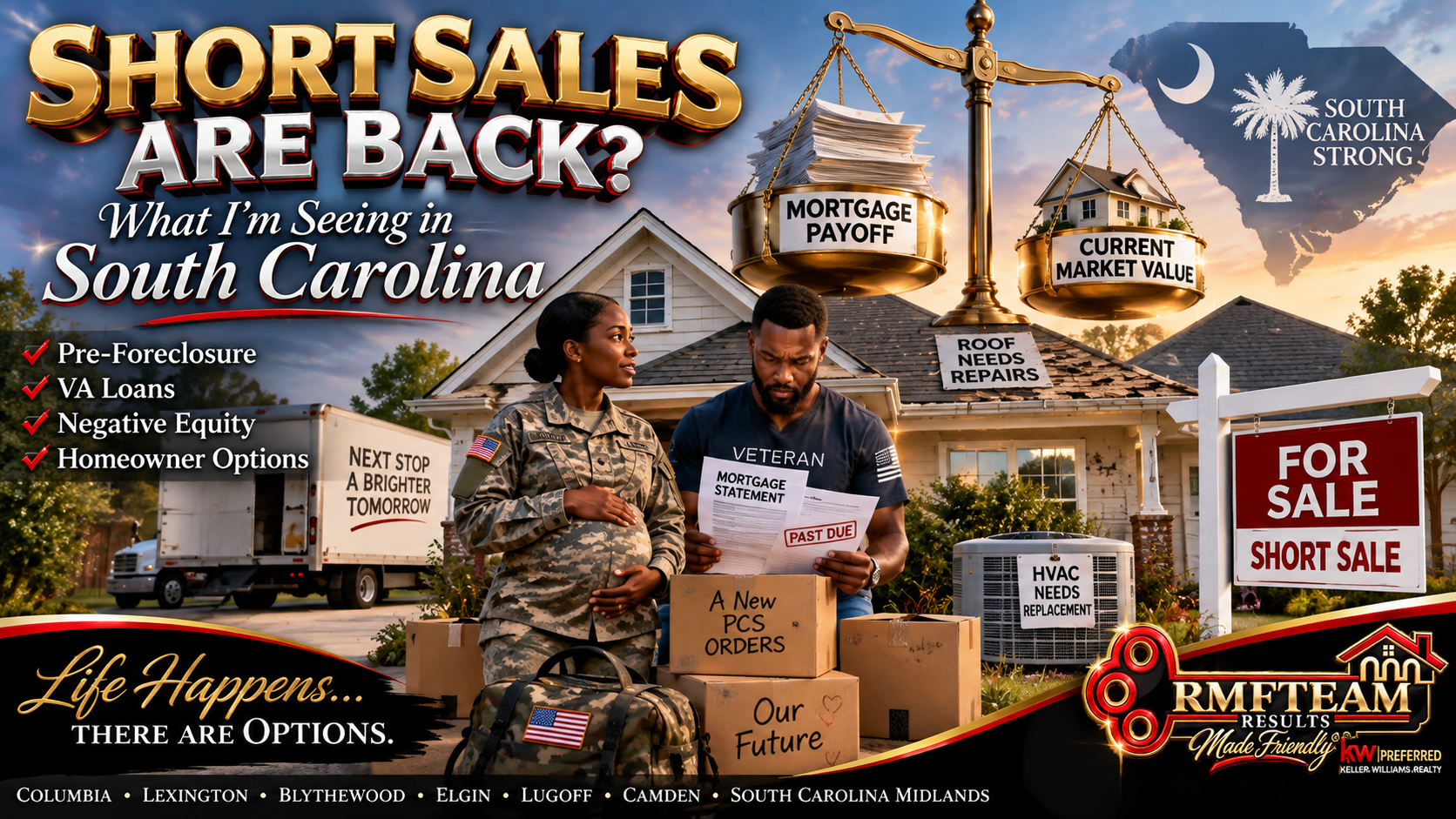
What I’m Seeing in South Carolina’s Changing Housing Market
This week, I’m attending the South Carolina REALTORS® Business Unusual Legal Conference, and one question keeps coming up when fellow real estate professionals learn that pre-foreclosure and short sales are not only my niche—they are my passion:
“Rozalyn, are you seeing short sales again?”
My answer is yes.
And some of the situations I’m seeing should get the attention of homeowners, real estate professionals, lenders and mortgage servicers.
South Carolina Short Sales Are Becoming Part of the Conversation Again
For years, many homeowners benefited from rapidly rising property values and accumulated substantial equity.
But that is not every homeowner’s story.
Some people who purchased during the pandemic-era housing frenzy bought when competition was intense and prices were climbing quickly. Some used VA financing, down-payment assistance or other low-down-payment financing that allowed them to become homeowners without beginning with a large equity cushion.
Now life is happening.
A military family receives PCS orders.
A job changes.
A divorce occurs.
Someone becomes ill.
Household income changes.
Or a homeowner simply has to move sooner than expected.
If the mortgage payoff, selling expenses and other obligations exceed what the property can realistically sell for, that homeowner can find themselves facing a difficult situation—even while homeowners around them may have significant equity.
That is when understanding South Carolina short sales becomes extremely important.
The Market Is Changing—and Buyers Are Paying Attention to Condition
One of the biggest challenges I’m seeing isn’t simply the sales price.
It’s the condition of the property.
Buyers are becoming more selective. A house needing a roof, HVAC system, plumbing work, electrical repairs or significant deferred maintenance may not command the same price as a comparable move-in-ready property.
That creates a difficult short-sale equation.
A mortgage servicer must determine whether the proposed sale meets its requirements. Meanwhile, the buyer is looking at the actual cost of owning the property after closing.
A buyer may be thinking:
“If I pay this price and then immediately have to spend thousands replacing the roof and HVAC system, does this purchase still make financial sense?”
That question matters.
In a short sale, we aren’t simply negotiating a sales price.
We’re trying to bring together market value, property condition, buyer expectations, repair costs, liens, closing expenses and the mortgage servicer’s required net proceeds.
Sometimes those numbers simply don’t line up without additional negotiation.
I Just Closed a VA Short Sale—and It Hit Home
Recently, I closed a VA short sale that reminded me exactly why I continue doing this work.
My seller was pregnant.
She had received orders requiring her to move, and she was struggling with the financial burden of maintaining two households.
Her home had already been on the market for more than a year.
Then we had another problem.
The property needed a heating and air-conditioning system.
The numbers were tight, and we were trying to get this transaction across the finish line.
Ultimately, I gave up my commission so the HVAC system could be installed and this Veteran could finally sell the home and move forward.
I don’t share that for applause.
I share it because there is a human being behind every short-sale file.
Our military families already sacrifice enough. When orders require a service member to relocate, the housing market doesn’t necessarily cooperate with the timing of those orders.
Sometimes getting a family out from underneath an unaffordable housing situation requires people to stop looking only at numbers on a spreadsheet and understand the story behind those numbers.
VA Short Sales Are Still an Important Foreclosure-Avoidance Option
The Department of Veterans Affairs continues to recognize short sales as an alternative to foreclosure when a Veteran owes more than the property can sell for. VA guidance says a servicer may agree to release its lien in exchange for the proceeds from the sale when applicable requirements are satisfied.
That doesn’t mean every VA short sale will automatically be approved.
It means homeowners should understand that foreclosure isn’t necessarily the only option when selling the property normally will not produce enough money to satisfy the mortgage.
Veterans should also understand that a short sale can affect future VA loan entitlement. VA advises borrowers to discuss their individual circumstances with a VA loan technician.
Are We Going to See More Short Sales?
That is the question I am being asked repeatedly.
No one can know exactly how many homeowners will ultimately need them, but there are warning signs worth watching.
ATTOM reported that 39,906 U.S. properties had foreclosure filings in July 2026, a 10% increase from July 2025. South Carolina recorded the second-highest foreclosure rate in the nation, with one foreclosure filing for every 2,085 housing units.
Foreclosure filings and short sales are not the same thing, and those statistics do not mean another 2008 housing crisis is underway. ATTOM itself notes that current foreclosure volumes remain relatively low by historical standards.
But they are a reminder that some homeowners are struggling.
And that’s why I believe real estate professionals need to start having these conversations before homeowners reach the courthouse steps.
Please Don’t Wait Until the Foreclosure Sale Is Around the Corner
This may be the most important message in this entire article.
If you’re struggling with your mortgage, ask for help early.
Don’t assume you have no options.
Don’t assume you have enough equity without actually running the numbers.
And don’t assume that because your neighbor’s house sold for a certain amount, yours will automatically sell for the same price—especially if your home needs substantial repairs or deferred maintenance.
A knowledgeable real estate professional can help evaluate:
Estimated market value + mortgage payoff + liens + property condition + repair needs + estimated selling expenses.
That calculation can provide a much clearer picture of whether you have equity, are close to breaking even, or may need to explore a short sale or another foreclosure-prevention alternative.
Short Sales Aren’t Just Transactions to Me
I entered real estate during the foreclosure crisis, and helping homeowners navigate difficult situations has remained one of the most meaningful parts of my career.
A short sale file isn’t just paperwork.
It’s often a family trying to figure out where they’re going to live next.
It’s a Veteran who received orders.
It’s a homeowner who lost income.
It’s someone going through a divorce.
It’s a family staring at a foreclosure notice and wondering whether they’ve waited too long.
Sometimes the greatest value a real estate professional brings isn’t selling a house.
It’s helping someone understand that they still have options.
If you’re a homeowner in Columbia, Lexington, Blythewood, Elgin, Lugoff, Camden or throughout the South Carolina Midlands and you’re behind on your mortgage, facing foreclosure, upside down on your loan or simply aren’t sure whether you can afford to sell, start the conversation early.
There may be more options than you think.
RMF Realty Team, LLC | Keller Williams Preferred
Real Estate Made Friendly®
Guiding you home with a smile.
This article provides general real estate information and is not legal, tax or financial advice. Short-sale and foreclosure options depend on the homeowner, loan type, servicer, liens and individual circumstances.
#SouthCarolinaShortSales #ShortSaleHelp #ForeclosureHelp #PreForeclosure #VAHomeLoan #VeteranHomeowners #SouthCarolinaRealEstate #ColumbiaSCRealEstate #MidlandsSC #RMFRealtyTeam #RealEstateMadeFriendly